
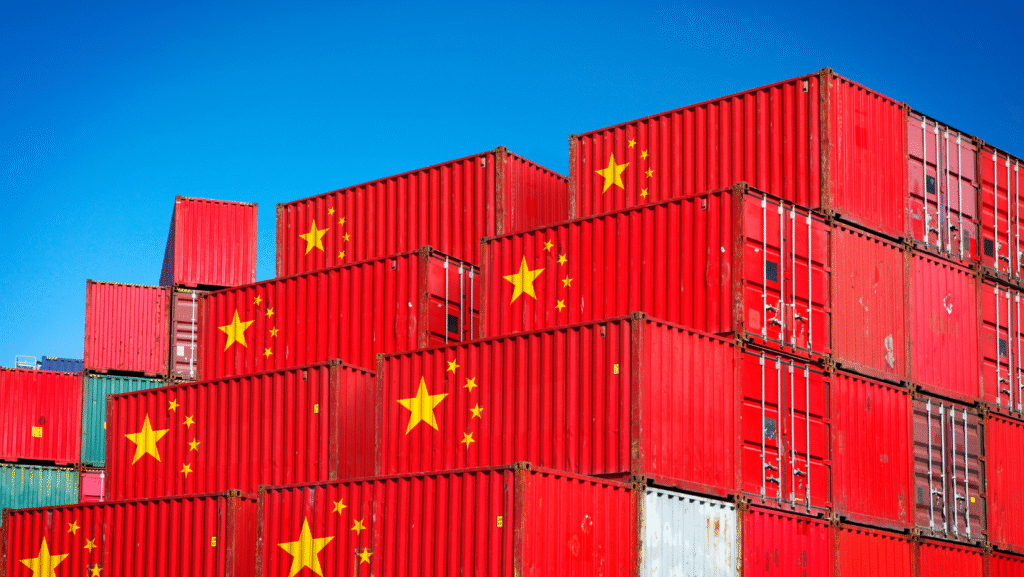
Chinese exports fall for the first time since the start of the trade war.
- Inma Bonet hightech123
- 07 NOV 2025 - 04:42 CST
China has begun to feel the effects of the trade war with the United States, six months after Donald Trump unleashed his global tariff storm. The dollar-denominated value of exports from the Asian giant fell 1.1% year-on-year in October—in yuan terms, the decline was 0.8%—according to figures released Friday by the General Administration of Customs. This marks the first contraction since April, the month in which the U.S. president announced what he called “Liberation Day,” and sharply contrasts with the 8.3% increase recorded in September, the best figure in six months.
The first sign that trade tensions between the two economic giants are beginning to affect China’s economy has surprised analysts, who had expected growth around 3%. The country’s GDP grew in the third quarter at its slowest pace in a year, 4.8%, compared to 5.4% in the first quarter and 5.2% in the second.
The recent decline in exports is partly due to the exhaustion of the artificial boost that had supported them over the summer, when companies advanced shipments to avoid tariffs. Another factor is the recent appreciation of the yuan, which has made exports more expensive and reduced the competitiveness of Chinese products in international markets.
The anticipated meeting between Trump and his Chinese counterpart, Xi Jinping, held last week in South Korea, concluded with an agreement to extend the trade truce between the two powers for one year, following weeks of cross-threats over China’s controls on rare earth exports and U.S. restrictions on technology products. The agreement, which includes partial reductions of certain tariffs and temporary suspension of others, is intended to ease tensions during a year marked by volatility in bilateral trade. Notably, rare earth exports surged 75% between September and October, according to calculations by EFE based on data released Friday.
Although China’s overall sales to the United States have steadily declined in recent months (falling 25.2% in October, following a 27% drop in September), this decline had until now been offset by increased shipments to the two regional blocs that dominate its trade partners: the Association of Southeast Asian Nations (ASEAN) and the European Union (EU).
However, exports to the EU barely grew 0.9% year-on-year in October, well below September’s 14.2% increase. The slowdown has also been felt in Southeast Asia, where sales rose 11%, the lowest pace since February, and in Africa, where growth moderated to 10.5% year-on-year, after September’s spectacular 56% rebound. In Latin America, exports grew a modest 2.1%, far below September’s 15.2%, a slowdown that experts attribute to Mexico’s efforts to tighten controls on Chinese imports in response to increasing pressure from Washington.